
Poway's Regional City Directory Shelf
There is no verified standalone Poway city-directory run with a confirmed publisher and year sequence. The dependable description is a regional one: Poway material may be found in San Diego City and County directories, county land collections, local-history files, and census material. That regional city directory route is the sound starting point. The coverage table keeps known holdings distinct from research gaps. “Exact run not verified” is a useful result because it prevents a guessed title or year from becoming a false lead.
| Collection | Years | Where Held | Access |
|---|---|---|---|
| San Diego City and County directories | Exact run and publisher not verified | San Diego History Center Research Archives and library catalogs | Catalog and onsite inquiry |
| Great Register of Voters | Local run not verified | San Diego History Center research materials | Archive inquiry |
| Newspaper Index | 1850-1903 | San Diego History Center research materials | Onsite reference inquiry |
| County deeds and maps | Deeds 1845-1930; maps 1854-present | ARCC Archives and public kiosks | Kiosk, archive, or order |
| SDCL Digital Collections | Dates vary by item | San Diego County Library Digital History | Free online browse and search |
| Federal census | 1790-1950 public nationally | National Archives and library databases | Free or onsite licensed access |
The county rows add a durable property trail when a city directory entry cannot be found. Historic births and deaths cover 1849-1986, with most material from 1860-1956. Historic marriages cover 1856-2020, with most material from 1873-1956. Original historic vital records remain closed in the archive, while copies route through the San Diego County Assessor/Recorder/County Clerk. A directory entry should therefore be treated as one layer in a larger record chain.
Why Poway Uses Regional City Directories
Poway was a rural and unincorporated place until 1980. The community had fewer than 1,000 residents at the end of the nineteenth century, and an 1887 description counted about 800 people in an agricultural valley. That scale helps explain why a regional volume could mention Poway without a separate Poway title. Orchard, vineyard, grain, dairy, and beekeeping records belonged to county and community networks long before modern municipal files.
Address evidence grows thicker after Poway Valley Homes brought subdivision growth in the late 1950s. A family may appear first under a rural road, farm description, or nearby locality, then later under a numbered tract address. The City of Poway history account supplies the local settlement and growth context needed to read those changes. A directory search should use old road names and nearby landmarks alongside the modern city name.
The regional framing also guards against a common mistake. A modern city filter can hide a pre-incorporation entry because the older record was created under county geography. Search the surname, road, institution, or locality in the regional index, then test the result against the address and date.
The official Poway history source image gives a useful place anchor for that rural-to-suburban transition.
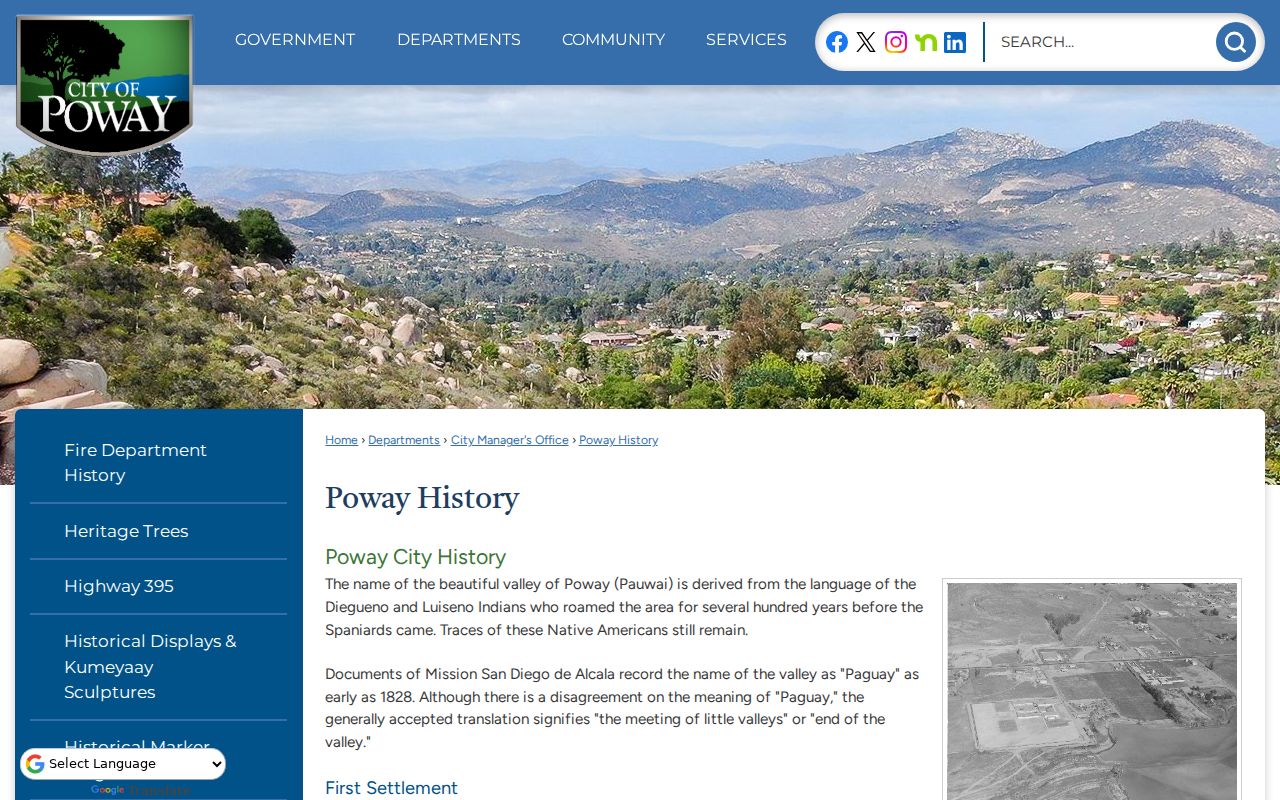
Its settlement focus helps connect a directory search to the valley landscape that preceded the present street grid.
What the Poway Directory Shelf Has Not Confirmed
Official online catalogs inspected for the research did not expose the publisher or exact year run of volumes that contain Poway. They also did not confirm a Poway reverse or criss-cross run, a telephone-book sequence, or a Poway obituary index. No individual should be quoted from an uninspected page, and no Polk year should be supplied by guesswork. A Poway city directory search should use the phrase “San Diego City and County Directories,” followed by a title and subject check in the shared catalog.
The Poway Library is the practical first contact for that shelf check. It is at 13137 Poway Road, Poway, California 92064, and its phone is 858-513-2900. Hours are Monday 10-6, Tuesday and Wednesday 12-7, Thursday 10-6, and Friday through Sunday 10-5. Staff can search the shared San Diego County Library catalog, request materials, and point a family researcher toward digitized local history. The San Diego History Center Research Archives is the other named checkpoint for regional directories, the Great Register, newspapers, vertical files, and oral histories.
A branch contact is more useful than a vague claim that a directory exists. Ask for the title or subject record, the cities and localities indexed, whether reverse sections are present, and whether a scan can be opened before copying any citation.
The Poway Library source image shows the local reference point for a Poway directory search.
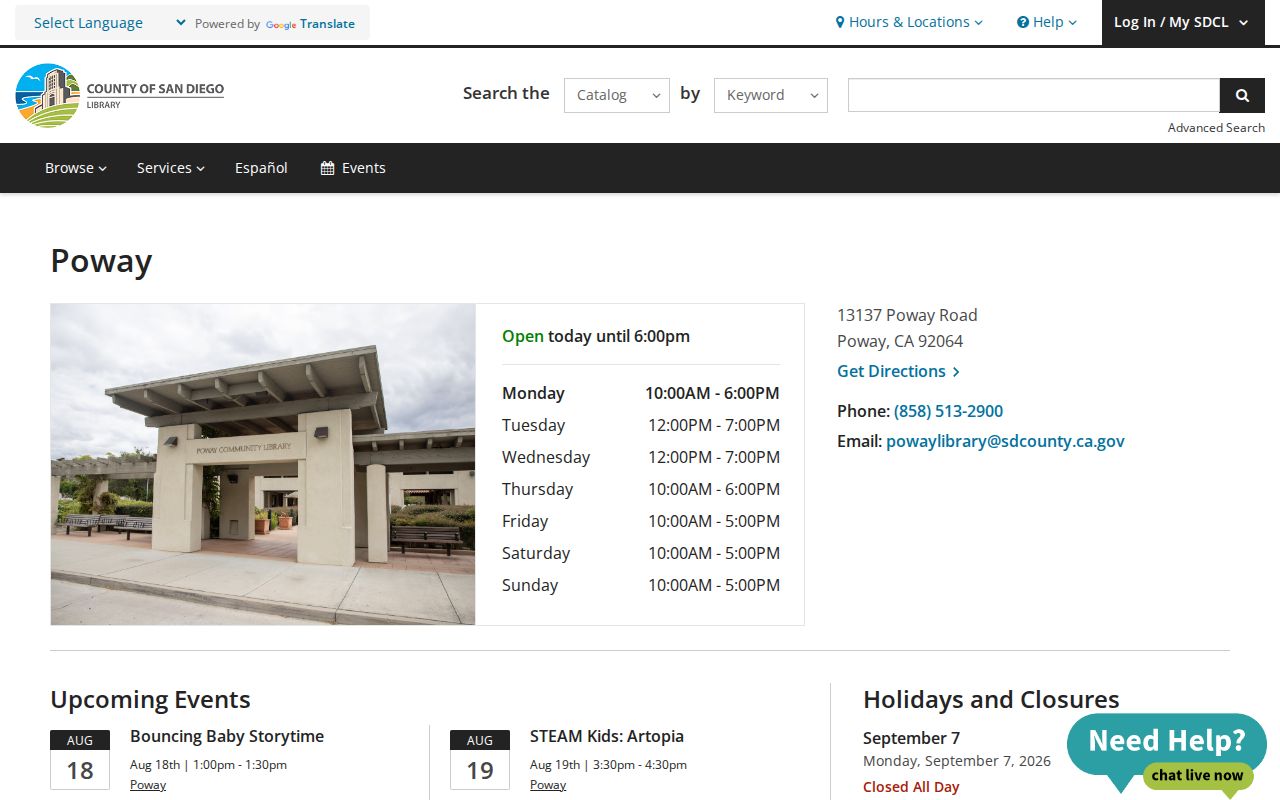
The location record confirms the branch details and provides the correct route for a shelf or catalog question.
San Diego History Center's Poway Trail
A city historical-evaluation bibliography records a strong local research recipe. Researchers used San Diego City and County directories with the Great Register of Voters, the Newspaper Index from 1850-1903, assessor building records, deed books, vertical and biographical files, and oral histories. That combination is more valuable than a bare name hit because each source answers a different question. A city directory can place a household; a deed can identify a land transfer; a newspaper or oral history can explain a move.
SDCL Digital Collections add a free online layer of photographs, maps, documents, and oral histories. Search metadata can connect a surname with a road, institution, landmark, or property story even when a printed directory is absent. Poway Historical and Memorial Society materials, Old Poway Park, Mary van Dam's As I Remember Poway, and official historic-property studies can then provide community context. These are historical clues, not substitutes for a certified civil record.
Use the local trail to test identity, not to turn a single reference into a complete household claim.
The SDCL Digital History source image gives a visual entry point to the regional archive route.
The collection is the place to search item metadata for Poway roads, names, landmarks, and local institutions.
How a Poway City Directory Entry Reads
No official scan of a Poway-containing volume was available for a quoted sample, but the genre-localized inventory shows what to record when a regional city directory page is opened. The entry is a finding aid, not a complete census. It can name a person, place a household at a road, and suggest a family link, while leaving other occupants unlisted.
| Name | Surname, given name or initial, with a spouse sometimes in parentheses |
|---|---|
| Family clue | Widow notation or a spouse name that helps distinguish people with the same surname |
| Occupation | A listed occupation that helps compare one person across years |
| Residence | House number and street, with residence marks such as h or r where supplied |
| Address type | Homeowner or renter marker, home, business, or boarding address when the volume gives that distinction |
| Reverse entry | Street name, house number, listed occupant or telephone, and sometimes vacant or business notation |
- Criss-cross directory
- A reverse section arranged by street and house number instead of surname, useful when the address is known first.
- Householder index
- An index that leads from a household name or head of household to the relevant entry or page.
- Abbreviation key
- The volume's explanation of marks such as h/r, emp, wid, and occupation shorthand. Photograph it before reading every line.
- Genre-localized inventory
- A description of the usual record fields, not proof that a particular Poway volume or individual entry has been verified.
Record the page, volume title, year, exact spelling, address, and any symbol before moving to another source. That citation keeps a useful clue separate from a fact that still needs confirmation.
Poway Directory Numbers Reach the 1840s
Numbers that matter: County kiosk holdings reach deeds from 1845-1930 and grantor/grantee indexes from 1846-1969. The historic Official Records group covers 1931-1989, while county maps extend from 1854 to the present. Those dates do not prove a local run. They show why a directory clue can be checked against a much older property trail even when the printed shelf is incomplete.
The County Archives also identifies historic births and deaths from 1849-1986, mostly 1860-1956, and marriages from 1856-2020, mostly 1873-1956. Originals are closed, so a researcher requests copies through ARCC instead of expecting an open reading-room browse. A directory clue can narrow which county record group deserves the next request.
The County Archives collection image reflects the dated holdings that support a Poway directory investigation.
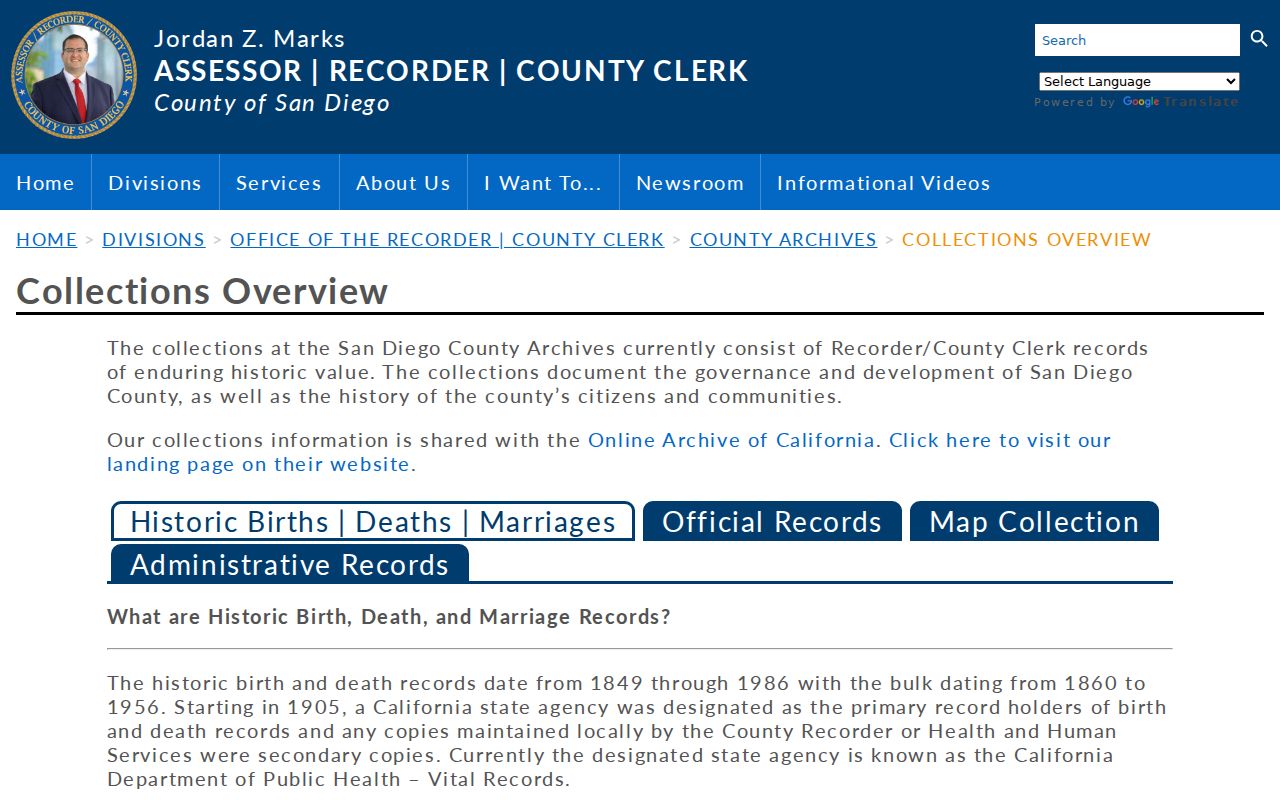
The collections overview is the best source for checking which group fits the date and record type.
Pair Poway Directories With the 1950 Census
The 1950 census is the latest fully public decennial census as of 2026 under the 72-year release rule. Poway entries before incorporation require care because the place was unincorporated. An old schedule may be organized by enumeration district or unincorporated-place geography rather than a modern Poway city filter. A city directory year around 1930, 1940, or 1950 can supply the spelling and road clue that makes the census search manageable.
The federal schedule adds relationship, age, birthplace, and occupation details that a directory may omit. The two records do not describe the same day, and a directory may list only selected household members. Treat agreement as support and disagreement as a prompt to check an address change, an absent rural delivery, or a different person with the same name.
The National Archives census research route explains the public release framework and helps place a Poway search in the correct enumeration geography.
- Write down the directory spelling, address, spouse clue, and occupation before opening a census schedule.
- Search the likely enumeration district or unincorporated place, not only the modern city name.
- Compare age, birthplace, relationship, road, and nearby names across the two records.
- Check the next directory year and the prior census when the household appears to shift.
- Mark each detail as directory, census, or corroborated rather than blending the sources.
The National Archives census source image is a useful reminder that a public census is a dated household snapshot, not a current resident roll.
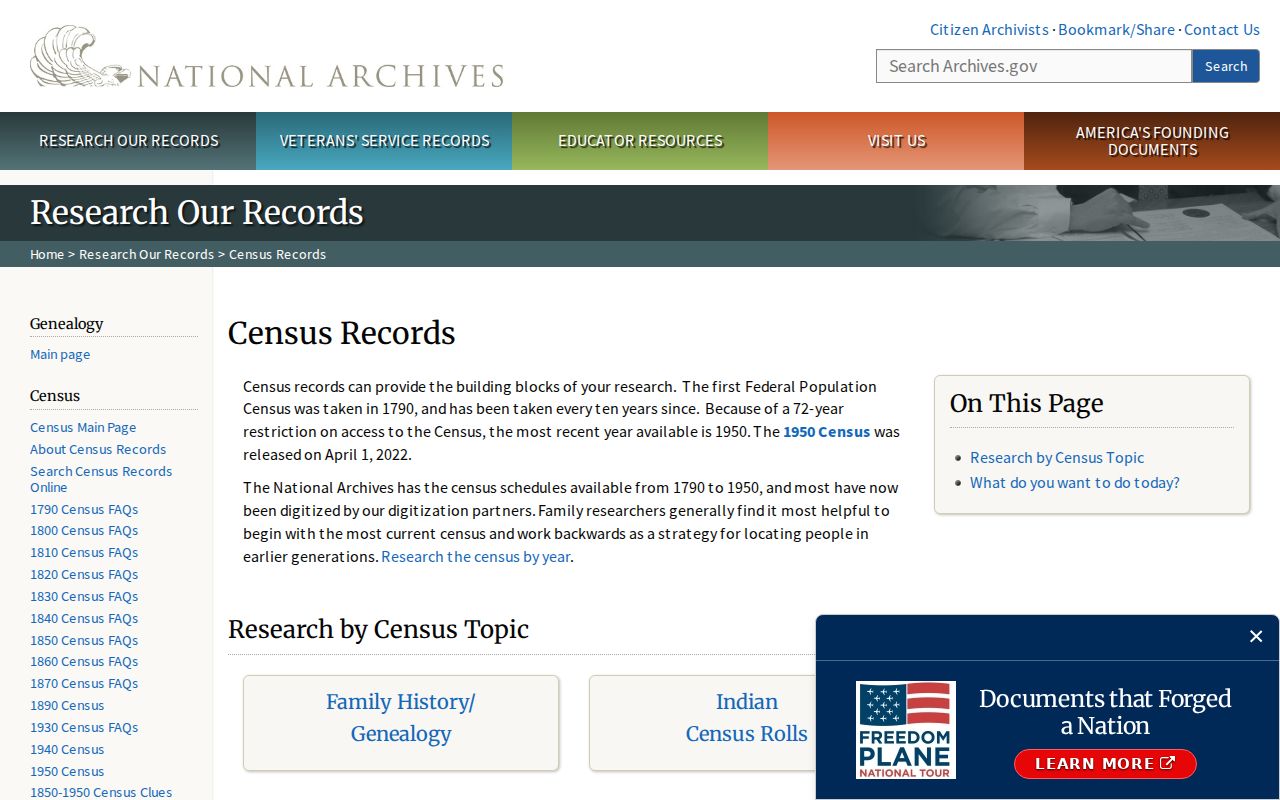
The image pairs naturally with directory research when the older geography is read on its own terms.
The Poway Sanborn Map Gap
A search of the Library of Congress Sanborn collection did not verify a Poway-specific sheet or year. The safe conclusion is a research gap, not a claim that no map ever existed. The belief that every California town has a Sanborn map is unsafe, especially for a rural valley whose growth came through farms and later subdivisions. A missing sheet should not end a house-history search.
Use PowGIS historical aerial imagery, county parcel and subdivision maps, and historic-property evaluations as the substitute trail. PowGIS can connect a present parcel to map geometry, engineering drawings, zoning information, and aerial history. A recorded map or legal description can bridge a boundary change more reliably than a modern street string. The Library of Congress Sanborn collection and PowGIS viewer belong in the same source log, with the gap stated plainly.
Map caution. No Poway-specific Sanborn sheet was verified. Parcel maps, recorded subdivision maps, and historical aerials are the sound local substitutes when the national map collection is silent.
Tracing a Poway Household Across Directories
A household trail works best when each city directory year answers one small question. Start with a surname and Poway road or locality, then move from the regional directory to the address, the parcel, and the county record that can confirm it. When the goal shifts from reading historical collections to walking one address backward, the Poway previous residents workflow keeps the deed chain and household layer together.
- Search the regional directory for the surname and Poway locality, and copy the exact spelling, spouse clue, occupation, and address.
- Check adjacent annual volumes for the first and last appearance. Absence may reflect an omitted rural delivery, a move, death, or an unlisted person.
- Use a reverse or criss-cross section when available, and note nearby house numbers and cross streets.
- Translate the address to a parcel, APN, and legal lot in PowGIS before connecting it to a deed or subdivision map.
- Pair 1930, 1940, or 1950 census schedules with obituary, probate, and vital evidence, while keeping occupants separate from owners.
Finish with the source that best explains the change. A first appearance may mark a move into Poway, while a last appearance may need an obituary, probate file, later directory, or a new road label before it can support a conclusion.
Poway's 1980 Records Fork
Poway's incorporation on December 1, 1980 is the key routing point for a directory search. Before that date, county record books, the Great Register, census schedules, church and cemetery sources, and regional directories carried most of the documentary load. After incorporation, city-created files such as permits, business certificates, council records, and GIS belong with Poway, while land title, assessment, vital records, voter registration, and court cases remain county or state functions.
The County Archives program was established in 2020, but the records it preserves reach back into the 1840s and 1850s. That distinction matters when a catalog date describes preservation rather than the date of a deed or map. A clear timeline prevents a modern archive label from being mistaken for the start of local record keeping.
- 1887: Poway appears as a small agricultural valley with about 800 people.
- Late 1950s: Poway Valley Homes marks the subdivision growth that creates denser address evidence.
- 1971: Lake Poway becomes a later place anchor for maps and local memory.
- December 1, 1980: incorporation divides earlier county material from later city-created files.
- 2020: the County Archives program consolidates preservation and access to permanent Recorder and Clerk material.
Read the date of the record, the geography used by the record maker, and the current custodian together. That three-part check keeps a Poway directory lead useful without turning an unverified run into a claimed local series.